Minor Mogul
Making movies independently
Sola ars nobis veritatem ostendit


Warner Bros. cartoons, then and now
By DTL
Posted August 25, 2004
When I was younger (so much younger than today), cartoons were a mainstay of children’s television programming. I loved ’em, and I watched ’em all.
I watched Tom and Jerry and Woody Woodpecker and Mighty Mouse and Sinbad Jr. and his Magic Belt and Marine Boy. The Hanna-Barbera factory churned out everything from The Flintstones to The Great Grape Ape Show, all of which lived forever in reruns. (Anyone remember Peter Potamus or Quickdraw McGraw or Hong Kong Phooey?) I learned to count to twelve the with the pinball machine on Sesame Street (“One two three four five . . . ”), and I loved “Letterman” on The Electric Company.
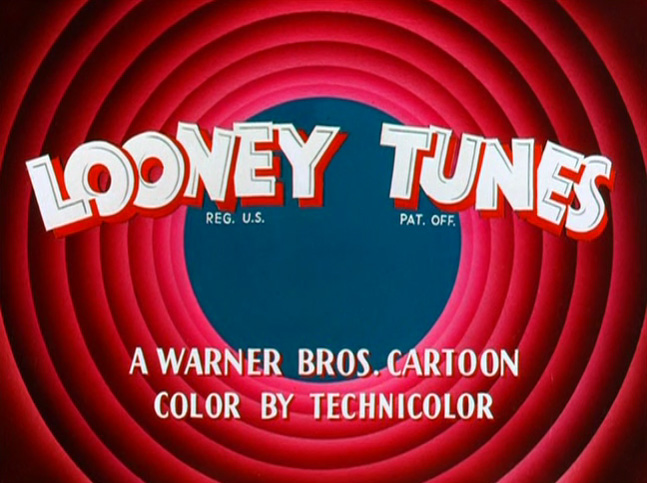
But for me, it was all about the Warner Bros. cartoons. Early in their evolution, the cartoons abandoned Disney’s “illusion of life” goal for impossible and outrageous slapstick. I identified with their spirit of anarchic exuberance.
The humour came from character. The regular characters like Bugs Bunny, Daffy Duck, Porky Pig, and Elmer Fudd were — sometimes textually — acting in the cartoons. You could picture them living lives offscreen.
The cartoons also had a remarkably consistent physics of their own. Things I learned from Warner Bros. cartoons:
- You don’t fall until you notice you’re standing in mid-air.
- You can breath in outer space.
- If you ingest alum, your head shrinks.
- Bullets and cannon-balls explode.
- Smashing through a wall will leave a hole in your outline.
- You can sometimes run into a painting on a wall.
- Any object you need can be obtained by reaching just offscreen.
- If you’re killed, you float upwards wearing a gown and wings.
Alas, cartoons are a dead art form today. The Simpsons has been limping along for at least five years on reputation alone. I prefer to believe that South Park ended with the movie. I loved Futurama; uneven though it was, showed great promise, so naturally it was killed. Everything Nickelodeon produces is poorly-conceived, minimally-animated drek. Spike and Mike’s Sick and Twisted Animation Festival has become nothing but sick and twisted: not funny, not inventive, not interesting, not even offensive; it’s boring.
And every time Warner Bros. tries its corporate hand at animated cartoons, it demonstrates afresh that it doesn’t understand what it has. Tiny Toons displayed a lack of faith in the old characters and a lack of imagination in the new ones. In Space Jam, Michael Jordan showed less depth than the ink-and-paint characters he shared the screen with; they, in turn, showed the depths of their characters by contrast, in constantly acting out of character. Animaniacs had its occasional moments, before relying too much on Pinky and the Brain; it reached back through the studio’s history to Bosko for the Warner siblings. Back In Action was under-written and over-produced.
What happened? What’s wrong with cartoons today?
One problem: the characters don’t have skeletons. There’s no sense of structure, of what a character’s capable of; they’re just rubbery all over the place. When they need a big reaction take, they have nowhere to go.
Another problem: producers caved in to pressure from parents’ groups to eliminate violence, innuendo, smoking, drinking, disrespect for authority figures, and any other source of humour. The parents are worried that these elements will warp their children. They may have a point; after all, these parents grew up on the old, violent cartoons, and look how they turned out.
A major problem is the fact of corporate ownership. The corporation that owns these characters doesn’t know what made those old cartoons so good. I will tell them (for all the good it will do): it was the creative talent. It was Chuck Jones, Friz Freleng, Bob Clampett, Robert McKimson, Tex Avery, Mel Blanc, Carl Stalling, Michael Maltese, and others.
But to a corporation, creative talent is infintely replaceable. Just hire some writers and artists, and they’ll make you cartoons. Quality is defined exclusively as outselling the competition, so the ineffable soul that made the old cartoons great is, by definition, beyond the comprehension of the corporation.
These characters aren’t cartoon stars any more; they’re marketable properties. They have to be kept respectable, their behaviouir within acceptable (dumbed-down) bounds, to safeguard the licenses sold to makers of Underoos and lunch boxes and colouring books.
It was only because the old cartoon unit was sequestered in “Termite Terrace” that they got away with making these things. Chuck Jones told of finagling the books to make more ambitious cartoons, because all the studio knew was that one seven-minute cartoon took so long to produce and cost so much in ink and paint.
But the old cartoons still exist, and they’re still great. On TV they’re bowdlerized and censored to the point of being unwatchable, but Warner Bros. puts them out in a new format every few years; buy, rent, or pirate them. We can still enjoy them.
And we can gain insight into ourselves. Bugs is what we want to be, but Daffy is what we are.
Latest items
- TLB reviews BC Buds (2024), a short comedy / thriller movie.
Favourite items
- “Don’t make these movies!” by MAT presents a list of movies that have already been made eleventy-squillion times, so you don’t need to make them again.
Submit to Minor Mogul
Minor Mogul always seeks articles about making movies independently, reviews of mainstream or indie movies, or narrative movies for the Showcase. See the submission guidelines.
Advertisement

This space is available for advertising purposes. Each time a page on this website is loaded, an ad is randomly chosen from all the ads that month.
A vertical business-card-sized (2" x 3½") image plus text costs $5 per month or $50 per year (two months free!).
If you’re interested, please see the ad guidelines.
Advertise with Minor Mogul